








A 2026 study by the Fraser Institute estimates that between 1997 and 2026, the cost of public health care insurance for the average Canadian family increased 2.3 times as fast as food, 1.7 times as fast as average income and 1.5 times as fast as shelter.
These figures estimate the portion of a family’s total taxes used to fund public health care. They are not direct insurance premiums or separate bills paid by families.
Understanding Public Health Care Costs
Adjusted for inflation, the portion of taxes attributed to health care rose by 137.1% from 1997 to 2024 for a representative one-parent, one-child family and by 82.8% for a two-adult family without children over the same period.
| Representative family type | Average cash income | Average total tax bill | Tax rate | Estimated tax share for public health care |
|---|---|---|---|---|
| 2 parents, 0 children | $147,542 | $70,824 | 48.0% | $16,528 |
| 2 parents, 1 child | $171,329 | $73,693 | 43.0% | $17,198 |
| 2 parents, 2 children | $176,266 | $75,904 | 43.1% | $17,713 |
| 1 parent, 1 child | $72,608 | $22,903 | 31.5% | $5,345 |
| 1 parent, 2 children | $80,862 | $21,032 | 26.0% | $4,908 |
| Unattached individual | $55,925 | $24,122 | 43.1% | $5,629 |
The estimates are based on the Fraser Institute’s Canadian Tax Simulator and are labelled as preliminary. They represent a portion of taxes attributed to public health care and do not reflect health care bills. The estimate does not decrease with private health care coverage.
The study focuses on health care at the macroeconomic level and does not provide insight into an individual’s health care needs or private coverage.
Source: The Price of Public Health Care Insurance, 2024.
The Role of Private Insurance
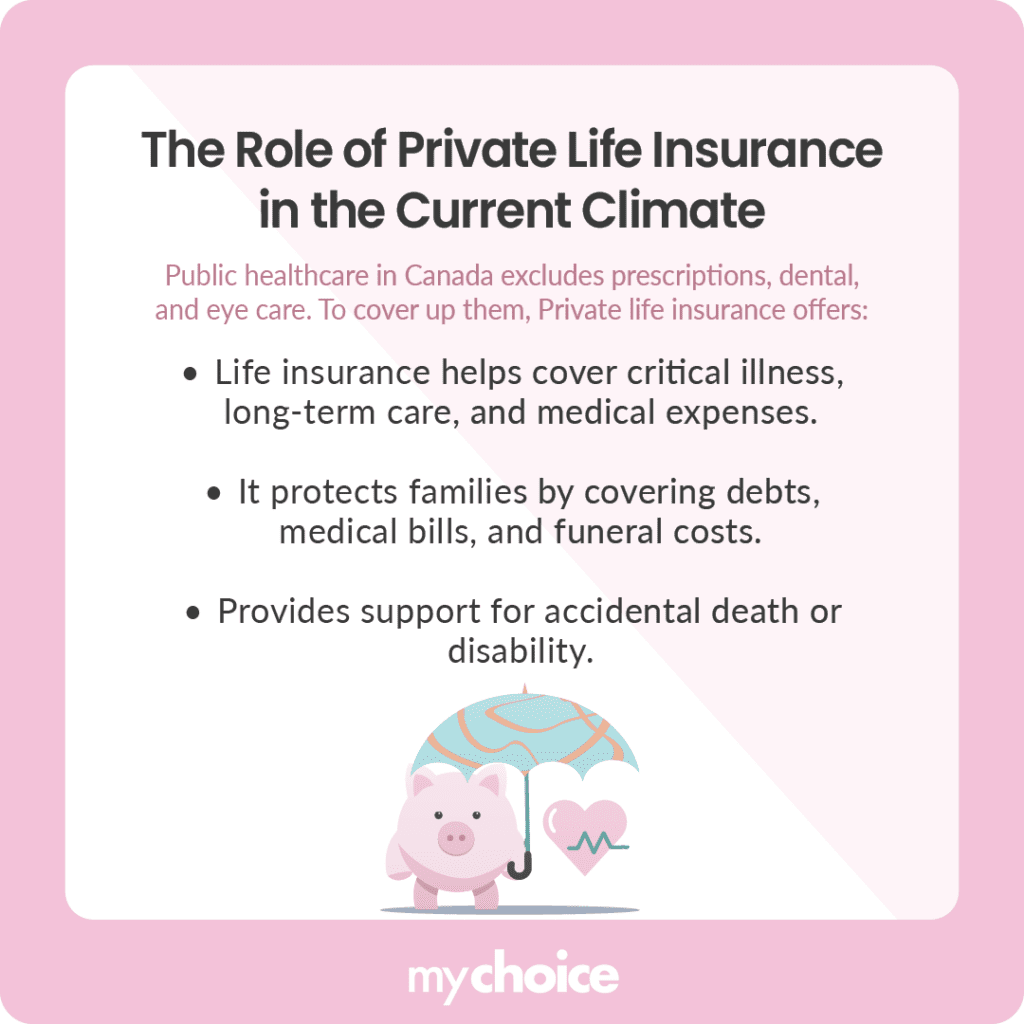
Public health care insurance in Canada is available to eligible residents of each province or territory. However, that doesn’t mean it is all-encompassing.
Public plans cover medically necessary hospital, physician and certain surgical-dental services. Provinces and territories decide whether to cover other services, such as prescription drugs, dental care and optometric care, in whole or in part.
Benefits from critical illness or long-term care insurance depend on the amount of coverage you choose, how the insurer defines a covered condition and the terms of the policy.
Life insurance serves a different purpose. It provides financial support to your beneficiaries after you die. The death benefit may be used for debts, funeral costs, lost household income or other expenses.
Before buying coverage, determine which financial risk you are trying to address and compare the policy’s benefit amount, exclusions, waiting periods and definitions.
Find the top life insurance companies in Canada.